The bubbles in that creek went further than I thought they would.
I was rinsing a stockpot at a campsite in Los Padres, the kind of dishwashing job that takes ten seconds with a squeeze of soap, and the suds rode the current downstream until I lost sight of them. Trout water, frog water, drinking water for the next people downhill. Whatever was in that bottle was now in their afternoon.
That trip was the last one I made with regular kitchen soap.
When you camp, your soap ends up somewhere. It soaks into the dirt where you slept, or it joins a creek that runs past wildlife and the people who never agreed to drink it. Environmentally friendly soap for camping exists because designers built kitchen-sink soap to flow down a kitchen sink. Streams aren't kitchen sinks. If you want the chemistry of how soap actually works before we go further, Wikipedia covers it well.
TL;DR Quick Answers
environmentally friendly soap for camping
Environmentally friendly soap for camping is plant-based, phosphate-free, and built to break down in soil rather than a kitchen sink. The watershed where you camp is downstream of whatever you wash with, which is the whole reason the category exists.
What to check before you pack:
Label ingredients, not adjectives. "Biodegradable" is not regulated on U.S. soap packaging. Read the back of the bottle for plant-based surfactants like coconut, olive, or potassium-based, and confirm there are no phosphates or synthetic fragrance.
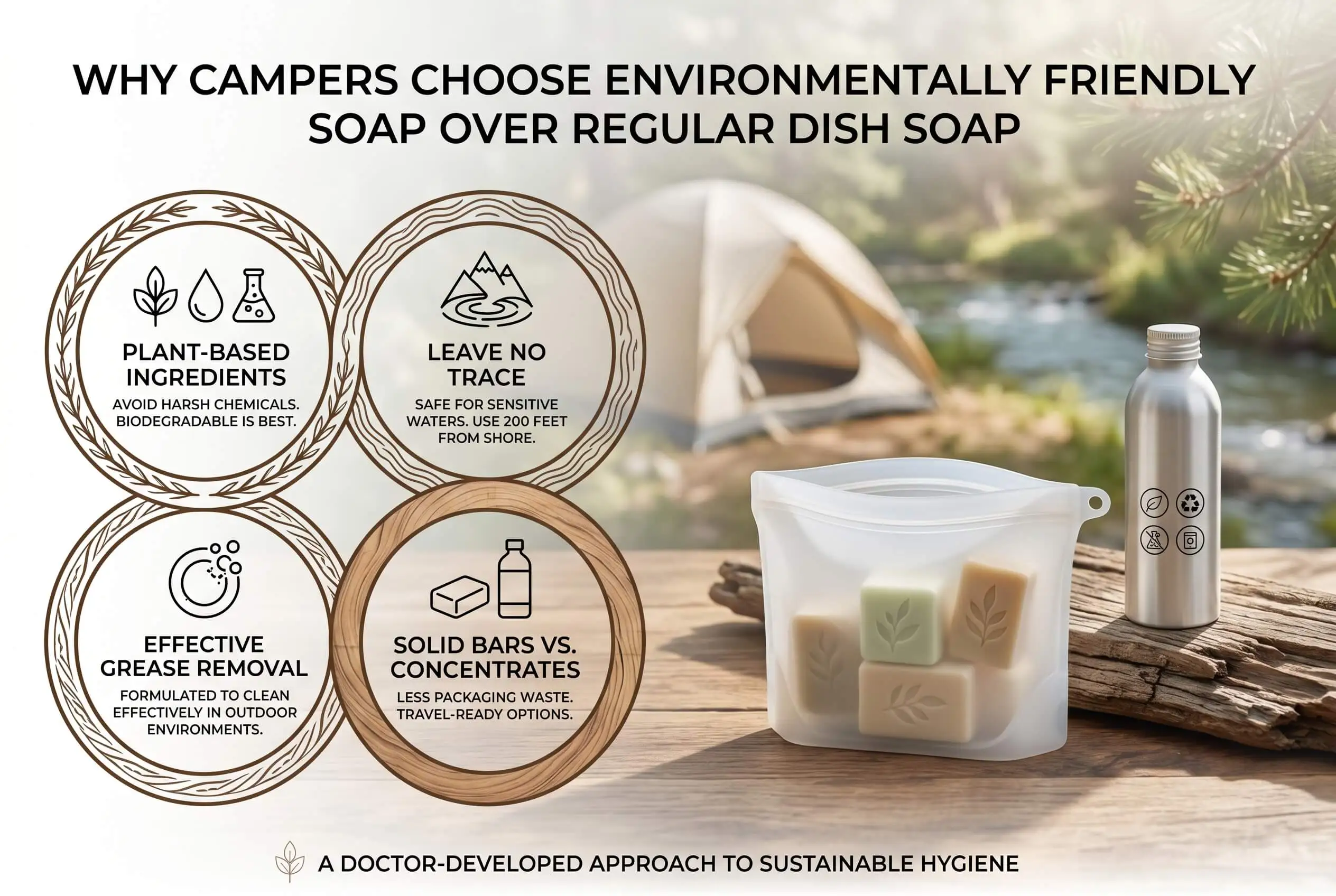
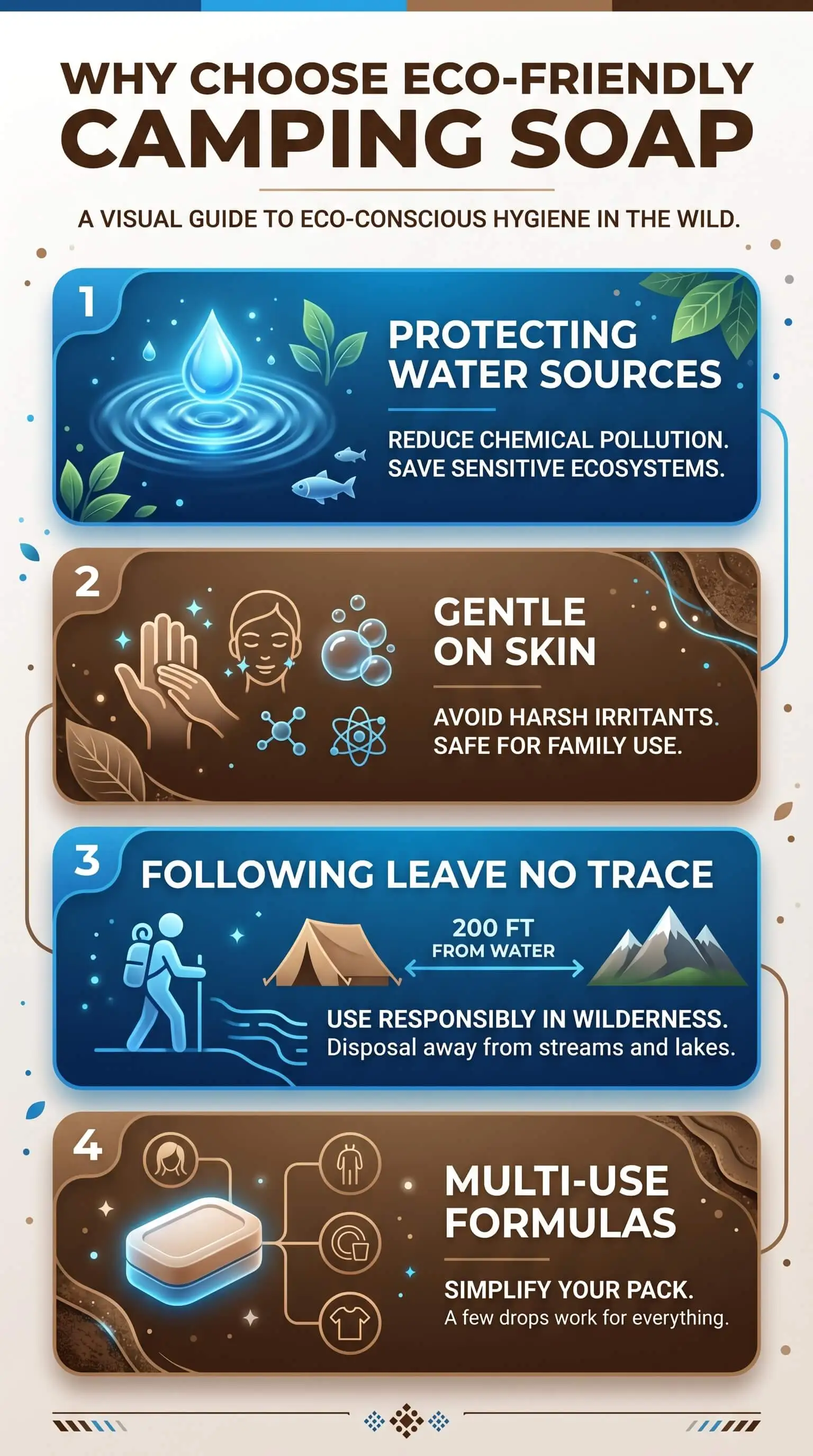
Wash 200 feet from water. That distance is the standard set by the National Park Service, REI, and the Leave No Trace Center for Outdoor Ethics. Even biodegradable soap needs soil and microbes to break down properly.
Match format to trip. Bar, concentrated castile liquid, sheets, or rinse-free. Rinse-free is the right pick for desert, alpine, or any trip where water is scarce, since it removes the wastewater question entirely.
Top Takeaways
• Manufacturers built regular dish soap for a kitchen sink, not for a forest floor. Its surfactants and phosphates harm aquatic systems whenever they reach a stream or lake.
• "Biodegradable" is not a regulated term on U.S. soap packaging. A label claim is not an ingredient list. Read the back of the bottle.
• Use soap at least 200 feet from any lake, stream, or spring. The National Park Service, REI, and every other major outdoor steward agree on that number.
• Two label signals do most of the work: plant-based surfactants and a phosphate-free formulation.
• Rinse-free camp soaps earn their price for trips where water is scarce. They take wastewater disposal off your worry list entirely.
• What you do with the soap matters more than the brand on the bottle. A great formula used carelessly still pollutes.
What Makes a Soap "Environmentally Friendly" for Camping
The problem with regular dish soap outdoors
Manufacturers designed your blue-bottle kitchen soap for a sink draining into a treatment plant, not for a forest floor. They load it with synthetic surfactants that cut grease at industrial speed, phosphates that keep glassware from spotting, and dyes and fragrances that do nothing useful outside the kitchen. Pour that same liquid into soil or a stream and the surfactants drop water's surface tension below what aquatic insects evolved to tolerate. The phosphates feed algae blooms that pull oxygen out of the water column.
You see the results without needing a chemistry degree: green ponds in summer, shoreline zones where fish disappear, and stretches of trout river that used to hold fish and no longer do, which is why choosing a hypoallergenic hand soap without phosphates or harsh additives matters outdoors. Phosphate-driven eutrophication is among the most studied forms of water pollution in freshwater ecology.
What "biodegradable" actually means (and doesn't)
Most camping guides skip past this part: the United States has no enforced legal definition of "biodegradable" on a soap label. A manufacturer can put the word on any bottle they want, and nobody in a regulatory office is checking. The standard most outdoor writers fall back on comes from chemistry. At least 90% of the formula breaks down into water, carbon dioxide, and biological material within six months, given the right soil and microbe conditions.
Two consequences for what you put in your pack.
A "biodegradable" label does not mean "safe to rinse into a stream." It means the soap will decompose if it lands in soil with enough microbial activity. Moving water is not soil. The same chemistry that lets biodegradable soap break down on a forest floor also keeps it from breaking down in a creek.
A label claim and an ingredient list are different things. The adjective on the front of the bottle and the actual chemistry on the back of the bottle live in different worlds. Read the back.
What to look for on a camp soap label
When I'm packing for a trip, four things go on my checklist:
• Plant-based surfactants like coconut, olive, or potassium-based
• No phosphates, and no high-concentration sulfates like sodium lauryl sulfate
• No synthetic dyes or added fragrance
• A concentrated formula so I'm carrying less plastic up the trail
A fifth option has reshaped how a lot of backcountry campers solve the wash question entirely. Rinse-free soap formats lift dirt and germs off your skin and clump them into bits you brush away, with no water in the equation. A rinse-free biodegradable camping soap is what I point friends toward for desert routes, anything above treeline, or any day when water is the most precious thing in the pack. The wastewater question disappears entirely because there is no wastewater.
The farm-stewardship habit of watching what enters the soil and what leaves it carries over to a campsite without much editing.
"Every farmer I know learns to pay close attention to where water comes from, where it leaves, and what it carries on the way out. On a working farm, the difference between soap that dissolves into the soil and soap that runs off into a creek is not a question of philosophy. It shows up in the fish in the pond a mile downhill. It shows up in what my neighbors' wells taste like. When I started paying that same attention on camping trips, the rule was already obvious to me: if the land cannot break the soap down, somebody downstream deals with what's left of it. That is the load campers carry now. Anyone who grew up around water already knows the answer. Stay back from the water source, use less than you think you need, and pick a formula the soil can actually digest."
7 Essential Resources
Whenever someone asks me where I get the camp-washing rules I follow, this is the short list I send them. Every URL was live when I checked it last.
1. National Park Service: Leave No Trace Seven Principles. The federal master document on the seven principles, including the wastewater and soap protocol that backcountry rangers actually quote. Start here if you read only one. nps.gov/articles/leave-no-trace-seven-principles.htm
2. U.S. Fish & Wildlife Service: Leave No Trace Principles. Short federal summary of waste disposal and washing practice, written for refuges, parks, and most public land. fws.gov/project/leave-no-trace-principles
3. U.S. Forest Service: No Trace Ethic. Forest Service field-side reminder on biodegradable soap use and strained dishwater disposal during backcountry trips. fs.usda.gov/lei/no-trace-ethics.php
4. REI Expert Advice: Leave No Trace Principles. Plain-language walkthrough from REI, with practical notes that distinguish frontcountry waste handling from backcountry waste handling. rei.com/learn/expert-advice/leave-no-trace.html
5. Appalachian Trail Conservancy: Leave No Trace on the A.T. Trail-specific guidance from the conservancy on washing dishes, bodies, and clothing 200 feet from water, and on using biodegradable soap sparingly. appalachiantrail.org/experience/hike-the-trail/at-basics/leave-no-trace
6. Wikipedia: Soap. The single-page chemistry and history primer behind everything else on this page: saponification, surfactants, hard versus soft soap. en.wikipedia.org/wiki/Soap
7. KOA Camping & Outdoor Hospitality Report. KOA's annual snapshot of who is camping in North America, how often, and where the trends are heading. Useful for sizing the cumulative footprint of campers' soap choices. koa.com/north-american-camping-report
Supporting Statistics
Three figures sit behind everything in this guide.
Over 52 million households camped in North America in 2025
That number comes from KOA's 2026 Camping & Outdoor Hospitality Report, the 12th annual edition. At that scale, the soap choices individual campers make stop being individual. A few million bottles times a few million washes equals real load on public lands and waterways. Source: KOA 2026 Camping & Outdoor Hospitality Report.
200 feet: the distance every major outdoor steward sets between your soap and any water source
The National Park Service, U.S. Fish & Wildlife Service, REI, the Appalachian Trail Conservancy, and Scouting America all publish the same 200-foot figure, drawn from Leave No Trace Center for Outdoor Ethics guidance. Even biodegradable soap needs soil and microbes to break down properly. Putting it directly into water skips the entire decomposition step. Source: National Park Service: Leave No Trace Seven Principles.
About 17.7% of Americans age 6 and older camped in 2023
The 2024 Outdoor Participation Trends Report from the Outdoor Foundation and Outdoor Industry Association puts camping in the top five outdoor recreation activities by participation rate, alongside hiking, fishing, running, and cycling. Many of those campers are new to the outdoors. The soap choices they make on their first few trips will set the habits they bring back for years. Source: Outdoor Industry Association press release.
Final Thoughts
After years of thinking about water on the farm and on the trail, here is the honest answer I landed on: the best environmentally friendly soap for camping is the one that gets formula, format, and field practice right at the same time.
Formula first. Plant-based surfactants, no phosphates, no synthetic dyes. All of that is visible on the back label if you read it.
Format is the next decision, and it depends on what kind of trip you're packing for. Concentrated castile liquid is hard to beat for family car camping. Backpackers usually switch to a bar to cut weight and drop the plastic. A sheet product is cheap and almost weightless for day trips. Rinse-free options are my pick for desert or alpine work, where water is the rarest thing in the pack.
Field practice is where most people slip up. No soap in any aisle, however expensive or however organic, gets you out of staying 200 feet from a stream and scattering your wastewater into the soil. The brand on the bottle matters less than what you do with it.
The farm connection is what I keep coming back to. Anyone who has worked rural land already knows what Leave No Trace teaches first-time campers: soil filters whatever soaks into it, and water carries whatever lands in it, a principle that also underpins profitable farming. Bring a soap that respects the system you are washing into. That is the whole argument.
Frequently Asked Questions
Is biodegradable soap safe to use directly in a lake or stream?
No. Biodegradable soap needs soil and soil microbes to break down properly. In moving water it acts like any other pollutant: surface tension changes, small aquatic organisms struggle, and the breakdown the label promised never happens on the timeline it suggested.
How far from water should I use biodegradable soap when camping?
At least 200 feet, which works out to roughly 70 to 80 adult steps. The same number shows up in National Park Service, U.S. Fish & Wildlife Service, Forest Service, REI, Appalachian Trail Conservancy, and Scouting America guidance.
Can I use Dr. Bronner's, Dawn, or Dove as camping soap?
Many backpackers use Dr. Bronner's at camp, and it qualifies as plant-based and concentrated, although the company still recommends keeping it well away from water sources. The companies behind Dawn and Dove formulated those soaps for household use, so phosphates, synthetic surfactants, and added fragrances are common in the line. Neither belongs in your backcountry kit.
What is the difference between camping soap and regular dish soap?
Manufacturers formulate regular dish soap for a sink connected to a treatment plant. Camping soap uses plant-based ingredients and skips the phosphates and strong synthetic additives, so the soil can break it down when you use it correctly.
Do I need a separate soap for hands, dishes, and body when camping?
Usually no. A concentrated castile-style soap or a rinse-free formula will clean hands, dishes, and body without trouble. Saving space in your pack is one of the quiet advantages of a good camp soap.
Are rinse-free soaps actually eco-friendly?
Yes, when the formula is plant-based and biodegradable. Skipping the rinse step also takes the wastewater question off the table. There's nothing to scatter or bury, and you don't have to walk 200 feet from camp to dispose of it. For drier trips, rinse-free is often the gentler choice across the board.
Pack Lighter, Leave Cleaner
If this gives you a new way to read a soap label before your next trip, pass it to the friend who always runs the campsite kitchen. And if you want more on how farm-stewardship thinking maps onto the trails you love, our other writing on homesteading and sustainable farm practices at Black Owned Farm is a good next stop.
