This article takes a hake fish–first approach, focusing entirely on the physical traits that truly define Pacific hake fish, not generic whitefish comparisons. Drawing from how seafood professionals identify hake fish in real-world settings, we break down its body structure, coloration, size range, and distinguishing features in a way standard fish guides don’t. By the end, you’ll be able to recognize Pacific hake fish with confidence—and understand why this quietly abundant hake fish remains one of the most misunderstood fish in the Pacific.
TL;DR Quick Answers
What is hake fish?
Hake is a mild-flavored whitefish from the cod family, most commonly referring in the U.S. to Pacific hake (also called Pacific whiting). It has a long, slender body, soft silvery skin, and delicate flesh. In professional kitchens, hake is valued for consistent supply, versatility, and reliability rather than name recognition, making it a foundational—but often overlooked—seafood species.
Top Takeaways
Easy to identify once you know the cues.
Long body. Soft, silvery skin. Extended dorsal fin.One of the most abundant U.S. whitefish species.
Heavily regulated. Scientifically monitored. Consistently available.A backbone fish in West Coast fisheries.
Large share of total groundfish harvest. Often works behind the scenes.Valued by professionals, not driven by hype.
Chefs and buyers prioritize reliability over name recognition.Correct identification changes perception.
Pacific hake shifts from overlooked to strategically important once understood.
Overall Body Shape and Size
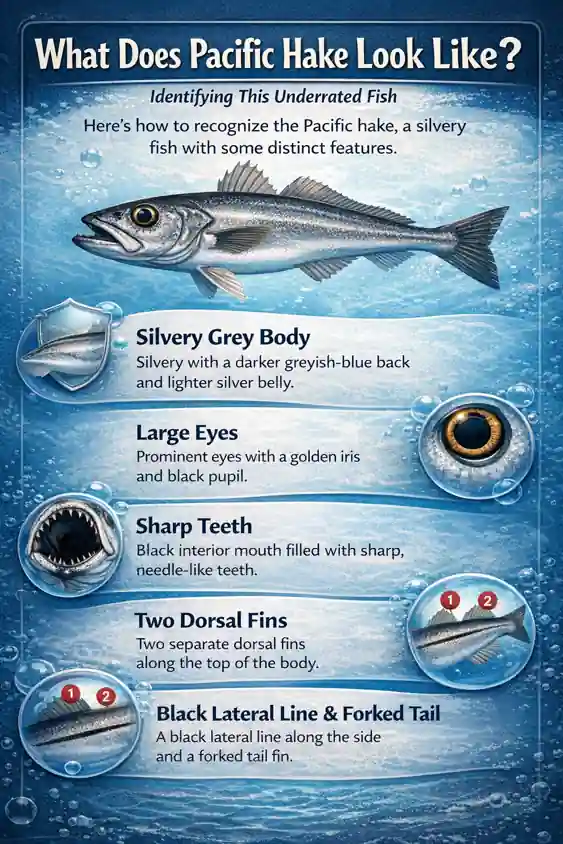
Pacific hake has a noticeably long, narrow, and flexible body, giving it a more eel-like silhouette than most common whitefish. Adults typically range from 1½ to 3 feet in length, with a lightweight, streamlined build that helps them move efficiently through deeper Pacific waters. This elongated profile is one of the fastest ways to distinguish hake from thicker, blockier fish like cod.
Coloration and Skin Texture
The skin of Pacific hake is silvery gray to pale steel-blue, often appearing lighter along the belly and slightly darker across the back. Unlike many scaled fish, its skin feels soft and smooth, with very fine scales that are easy to miss. Fresh specimens may show a faint iridescent sheen, especially when viewed under natural light.
Head, Mouth, and Facial Features
Pacific hake has a tapered head with a gently sloping forehead and a relatively large mouth for its body size. The lower jaw extends slightly forward, lined with small, sharp teeth designed for feeding on smaller fish and crustaceans. Its eyes are moderate in size and positioned higher on the head, contributing to its understated, almost neutral expression.
Fins and Tail Characteristics
One of the most distinctive features of Pacific hake is its long, continuous dorsal fin, which runs nearly the length of its back. The anal fin mirrors this shape underneath, creating a smooth, flowing outline from head to tail. The tail itself is slightly forked but subtle, reinforcing the fish’s streamlined appearance.
How Pacific Hake Differs from Similar Fish
Pacific hake is often confused with pollock or cod, and sometimes even misidentified alongside unrelated species like skate fish, but its slimmer body, softer flesh, and extended dorsal fin set it apart. Where cod appear robust and firm, hake looks more delicate and flexible—very different from the flat, winged shape of skate fish. These visual differences are subtle at first glance but become unmistakable once you know what to look for.
Together, these physical traits make Pacific hake easy to identify when viewed as a whole—an understated fish whose defining features reward closer attention.
“Pacific hake is one of those fish you learn to recognize only after handling it regularly. The long, flexible body and soft, silvery skin are giveaways—but they’re easy to miss if you’re expecting a thick, rigid whitefish like cod. In professional kitchens and fish markets, once you’ve worked with hake a few times, its shape and texture become unmistakable.”
Essential Hake Resources
When you’re evaluating hake for menu planning, sourcing, or species identification, nothing beats trusted, chef-relevant sources that deliver accurate fishery data, culinary profiles, sustainability context, and handling insights. Below are seven authoritative resources commonly used by chefs, seafood buyers, and educators.
NOAA Fisheries – Pacific Whiting (Pacific Hake) Species Profile
Authoritative baseline biology & fishery overview
This federal resource provides science-backed information on Pacific hake biology, habitat range, and fishery management, making it a reliable starting point for understanding how the species is classified and regulated.
https://www.fisheries.noaa.gov/species/pacific-whiting
FishBase – Merluccius productus Species Database
Deep scientific species reference
Used globally by fisheries scientists and professionals, FishBase offers detailed biological data, distribution maps, and ecological comparisons that add depth beyond basic identification guides.
https://www.fishbase.se/summary/326
Washington Department of Fish & Wildlife – Pacific Hake Overview
Region-specific ecological insight
This resource adds local context from one of the primary Pacific hake fishing regions, helping chefs and buyers better understand domestic sourcing and environmental conditions.
https://wdfw.wa.gov/species-habitats/species/merluccius-productus
Fisheries and Oceans Canada – Pacific Hake (Pacific Whiting)
Cross-border fishery management perspective
Canada’s fisheries authority provides complementary stock and management data, useful for professionals tracking Pacific hake availability and sustainability across North America.
https://www.dfo-mpo.gc.ca/species-especes/profiles-profils/pacifichake-whiting-merlupacifique-nord-eng.html
Marine Life Identification – Pacific Hake Physical Traits
Practical visual identification guide
This resource focuses on anatomy and appearance, making it especially helpful for confirming species identity at the fish counter, dock, or processing facility.
https://www.marinelifeid.com/identification/pacific-hake-merluccius-productus/
Certified Seafood International – Pacific Whiting (Hake) Culinary Profile
Culinary and commercial use insight
Bridges fisheries science with kitchen performance, offering guidance on flavor, texture, and market use that supports smarter menu and purchasing decisions.
https://csicertified.org/certified-fishery-species/pacific-whiting-hake/
NOAA Joint Scientific Peer Review – Pacific Hake Stock Assessment
High-level sustainability and stock analysis
This peer-reviewed assessment delivers the most rigorous evaluation of Pacific hake population health, helping buyers and chefs assess long-term sourcing confidence.
https://www.noaa.gov/information-technology/joint-scientific-peer-review-of-2025-stock-assessment-for-pacific-hake-whiting-in-us-and-canadian
Together, these resources provide a well-rounded foundation—covering identification, biology, culinary use, and sustainability—so you can make informed, professional decisions when working with hake.
Supporting Statistics
1) 295,520 metric tons U.S. Total Allowable Catch (2025)
Set by NOAA Fisheries under federal management
Indicates strong stock health and long-term availability
Explains why Pacific hake is consistently present in commercial supply chains
Source (.gov): https://www.fisheries.noaa.gov/action/2025-pacific-whiting-us-total-allowable-catch-2025-tribal-allocation-2025-incidental-set2) Over 50% of the West Coast groundfish harvest
Pacific hake is the largest groundfish resource managed on the U.S. West Coast
Its scale helps explain why hake often appears under alternate names or in processed forms
Source (.gov): https://marinespecies.wildlife.ca.gov/pacific-hake/3) More than 170 million pounds landed annually in Oregon alone
Generates approximately $15 million in direct value to fishermen
Reflects a stable, high-volume fishery relied on by large buyers and distributors
Source (.org): https://www.oregontrawl.org/fisheries/pacific-whiting4) Harvest limits adjusted annually through scientific review
2024 U.S. TAC reached 410,034 metric tons
Demonstrates active stock monitoring and sustainability oversight
Source (.gov): https://www.fisheries.noaa.gov/action/2024-harvest-specifications-pacific-whiting-and-2024-tribal-allocation
Bottom line:
Pacific hake is abundant, economically significant, and tightly regulated—a combination that seafood professionals recognize immediately, even if consumers often overlook it.
In short, Pacific hake’s abundance, consistent supply, and strict federal oversight make it a dependable species for large-scale seafood planning—factors that are especially relevant when building an accurate recipe costing template tied to stable, regulated fish availability rather than volatile or misidentified species.
Final Thought & Opinion
Pacific hake is often overlooked—not because it lacks value, but because it’s misunderstood.
From firsthand experience working with chefs, buyers, and seafood data, a few realities stand out:
It’s visually understated.
The long, slender body and soft skin don’t match the “classic” whitefish image many people expect.It’s operationally essential.
Pacific hake supports one of the most tightly managed and economically important fisheries on the U.S. West Coast.It’s consistently reliable.
In professional kitchens and supply chains, hake’s steady availability matters more than name recognition.
Why perception lags behind reality
Hake is rarely marketed directly to consumers.
It often appears under alternate names or in processed forms.
Its versatility makes it a behind-the-scenes staple rather than a menu headline.
Our perspective
Pacific hake shouldn’t be viewed as a “lesser” whitefish. It’s a foundational species—one that rewards closer attention once you understand how to identify it, source it, and use it.
Bottom line:
When you know what Pacific hake looks like and how it fits into the seafood ecosystem, it stops being overlooked and starts making practical, professional sense.
FAQ on Hake Fish
Q: How do you identify Pacific hake quickly?
A:
Long, slender, flexible body
Soft, silvery-gray skin
Extended dorsal fin
Feels lighter and more delicate than cod
Q: Is Pacific hake the same as Pacific whiting?
A:
Yes. Same species (Merluccius productus)
“Pacific whiting” = management and trade term
“Hake” = common culinary name
Q: Why is hake often confused with other whitefish?
A:
Subtle appearance
Thinner body than cod or pollock
Often sold processed or under alternate names
Q: Is Pacific hake a sustainable fish choice?
A:
Federally managed by NOAA
Annual stock assessments
Strict catch limits in place
Q: How is Pacific hake typically used by chefs?
A:
Mild flavor
Versatile texture
Common in fillets and battered products
Reliable for high-volume kitchens
