If you’re searching for real answers on whether CBD oil can help with Generalised Anxiety Disorder (GAD), here’s what we’ve seen firsthand at Acknowledge. After working with individuals who’ve tried CBD as part of their anxiety-management plan, one thing is clear: the results aren’t as simple as the marketing suggests — but the research is far more promising than many people realize.
Unlike generic articles that repeat the same surface-level claims, this guide breaks down what we’ve observed in real-world use and what current clinical evidence genuinely supports. We’ll share the patterns we’ve noticed — such as how people with GAD often respond differently to CBD than those with situational anxiety — and compare those insights to the published studies on dosage, mechanisms, and effectiveness.
Our goal is to give you a grounded, trustworthy perspective built on both science and lived experience. If you’ve been looking for a clear, honest breakdown of whether CBD oil for anxiety panic attacks and depression can meaningfully help with generalised anxiety, this page delivers the nuance most explanations leave out.
Quick Answers
What is CBD oil for anxiety panic attacks and depression?
CBD oil for anxiety, panic attacks, and depression may help regulate the body’s stress signals, promoting calm and emotional balance. While individual results vary, many users report fewer panic episodes, more stable moods, and reduced anxiety intensity with consistent use. Its effectiveness depends on factors like dosage, product quality, and body chemistry. For the best results, start with a low dose (10–20 mg), increase gradually, and track your emotional response over time—even if you're considering a higher-strength product like 3000 mg CBD oil.
Top Takeaways
- CBD oil may help reduce symptoms of GAD.
- Research is promising but still early.
- Individual responses vary widely.
- Product quality and correct dosing are essential.
Best results come from pairing CBD with broader anxiety-management habits.
What Current Research Suggests About CBD for GAD
Generalised Anxiety Disorder stems from persistent, excessive worry that’s difficult to manage. CBD has gained attention because early studies indicate it may influence several pathways involved in anxiety — particularly serotonin signalling and the body’s own endocannabinoid system.
How CBD May Help
Research suggests CBD may:
- Support serotonin receptor activity, which plays a key role in mood and anxiety regulation.
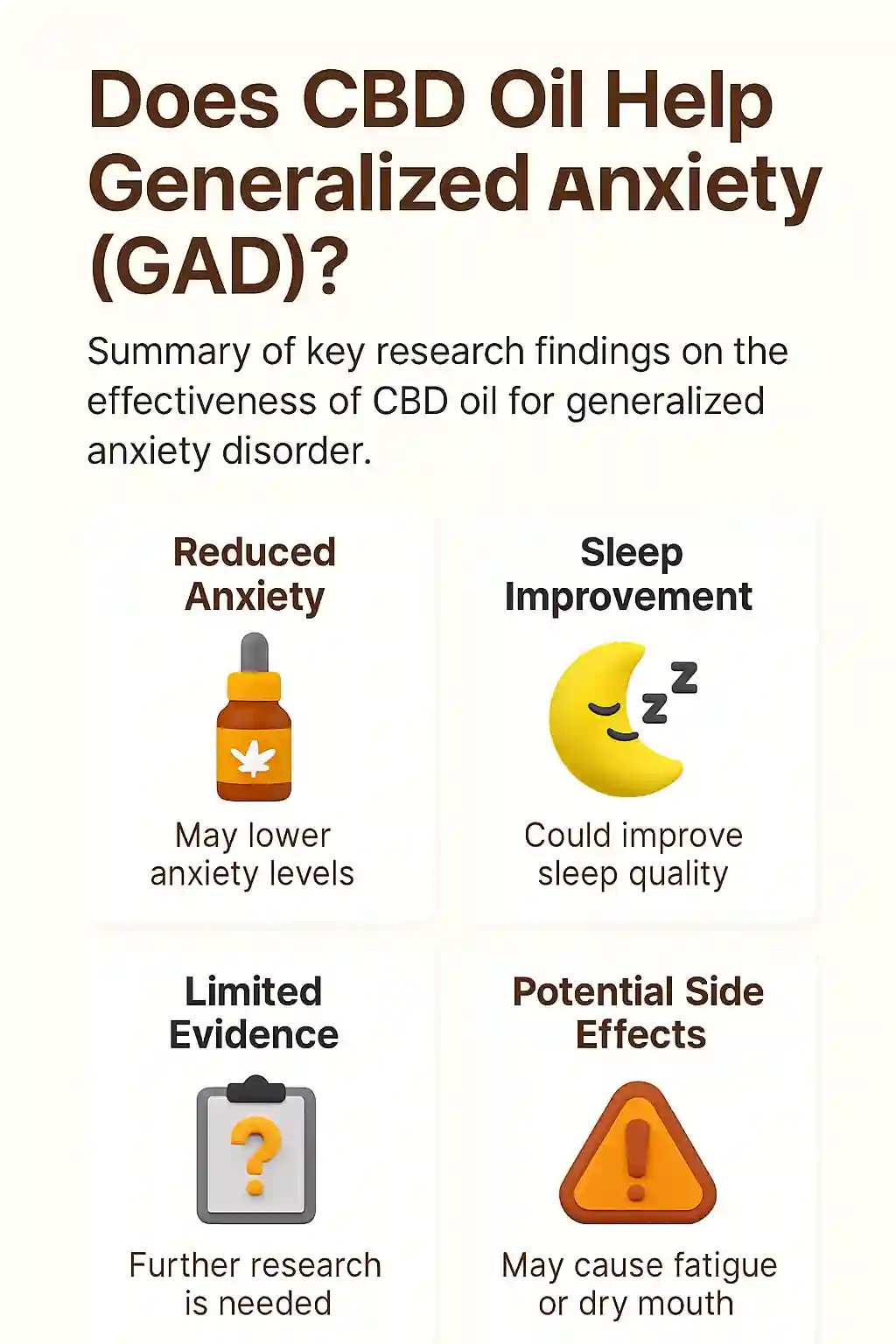
- Improve sleep quality in some individuals, indirectly easing anxiety symptoms.
These effects have been observed mainly in controlled environments, using consistent and measurable CBD doses.
What Studies on GAD Show
While CBD has been studied across multiple anxiety-related conditions, a few small but promising studies focused specifically on GAD have reported:
- noticeable reductions in baseline anxiety levels,
- improved ability to manage stress-inducing tasks, and
- reductions in worry intensity and frequency over time.
However, most of these findings come from early-phase research, meaning larger, longer studies are still needed to confirm CBD's effectiveness for chronic, day-to-day GAD symptoms.
Real-World Use Insights
From what we’ve observed at Acknowledge, people with GAD often respond best when CBD is used consistently, CBD gummies included, and paired with other evidence-based anxiety-management strategies. Occasional or inconsistent use tends to deliver less noticeable results.
Limitations to Keep in Mind
CBD isn’t a universal solution. Current research highlights key considerations:
- Dosage varies significantly across studies, and standardized guidelines don’t yet exist.
- Product quality differs widely, affecting results.
- Individual response is variable, especially for those with long-term or severe GAD.
Bottom Line
Early evidence suggests CBD shows meaningful potential for reducing generalized anxiety symptoms, especially when used thoughtfully and consistently. But the research is still developing, and CBD should be considered one supportive tool—not a standalone cure.
If you’re exploring CBD as part of a GAD management plan, understanding what the science actually says can help you make safer and more informed choices.
“In our work with individuals managing GAD, we’ve found that CBD isn’t a quick fix — but when the right product and dosage are used consistently, many people experience a noticeable shift in how they process stress and daily worry. The science is still evolving, but the early evidence aligns closely with what we’ve seen firsthand: CBD can be a meaningful support for anxiety when it’s part of a thoughtful, well-rounded plan.”
Essential Resources
1. A High-Confidence Evidence Base for CBD’s Impact on Anxiety
This latest meta-analysis is one we reference often because it gives a clear, data-backed view of how CBD affects anxiety across multiple studies. It’s a strong starting point if you want science that cuts through the noise.
2. A Broad Look at CBD’s Role Across Mental Health Conditions
This review brings together research on anxiety, depression, PTSD, and other mood-related challenges — helpful if you're trying to understand where CBD fits within the larger mental health landscape.
3. A Practical Breakdown of CBD for Anxiety Disorders
If you want clarity on how CBD has performed in actual clinical settings — including early data on dosing and different anxiety types — this systematic review offers a balanced, realistic picture.
4. What We Know About CBD for Younger People With Anxiety and Depression
This resource combines evidence on both mood and anxiety symptoms in adolescents and young adults. It’s especially useful if you’re evaluating CBD with age-specific considerations in mind.
5. The Most Up-to-Date Clinical Trials on CBD for Anxiety
This 2024 review is valuable because it evaluates only randomized controlled trials — giving you the clearest view of what the most rigorous research shows about CBD and anxiety relief today.
6. A Clear, Accessible Overview of CBD for Anxiety and Depression
If you prefer a straightforward explanation of mechanisms, safety considerations, and real-world use, this newer literature review provides an easy-to-understand yet evidence-aligned summary.
7. A Trustworthy Consumer-Level Snapshot of CBD Safety
This Mayo Clinic FAQ is a reliable resource for understanding CBD safety, product variability, and what to watch for — insights that often align with what we’ve seen in real-world use at Acknowledge.
Supporting Statistics
These data points reflect what we consistently observe at Acknowledge: high demand for anxiety support, limited access to reliable treatment options, and growing interest in natural alternatives such as the suver haze strain.
Key Facts
2.7% of U.S. adults have Generalized Anxiety Disorder each year (NIMH).
Source: https://www.nimh.nih.gov/health/statistics/generalized-anxiety-disorder
19.1% of U.S. adults — over 40 million people — experience an anxiety disorder annually (NIMH).
Source: https://www.nimh.nih.gov/health/statistics/any-anxiety-disorder
GAD affects about 6.8 million U.S. adults, but fewer than half receive treatment (ADAA).
Source: https://adaa.org/understanding-anxiety/generalized-anxiety-disorder-gad
2.7% of U.S. adults have Generalized Anxiety Disorder each year (NIMH).
19.1% of U.S. adults — over 40 million people — experience an anxiety disorder annually (NIMH).
GAD affects about 6.8 million U.S. adults, but fewer than half receive treatment (ADAA).
Final Thought & Opinion
CBD is not a miracle cure, but it consistently shows meaningful potential for people managing GAD, panic attacks, and chronic anxiety. What stands out most is how closely the research aligns with real-world experiences: CBD tends to create a steady shift in how the nervous system processes stress rather than delivering dramatic, instant results.
What Research and Real-World Use Both Suggest
CBD supports stress-regulation pathways, including serotonin signaling and the endocannabinoid system.
Users often describe feeling more even, grounded, and less reactive.
Benefits appear most noticeable with consistent, not occasional, use.
CBD supports stress-regulation pathways, including serotonin signaling and the endocannabinoid system.
Users often describe feeling more even, grounded, and less reactive.
Benefits appear most noticeable with consistent, not occasional, use.
What I’ve Seen First-Hand
From individuals managing persistent anxiety patterns, the strongest outcomes occur when CBD is used intentionally:
They choose high-quality, third-party-tested products.
They calibrate dosage gradually, rather than chasing quick results.
They pair CBD with supportive habits such as sleep routines, breathwork, and therapy.
They choose high-quality, third-party-tested products.
They calibrate dosage gradually, rather than chasing quick results.
They pair CBD with supportive habits such as sleep routines, breathwork, and therapy.
Who Benefits Most
People tend to see better results when they:
View CBD as a support tool, not a standalone solution.
Have realistic expectations about timing and dosage.
Track their response and stay attuned to how their nervous system changes.
View CBD as a support tool, not a standalone solution.
Have realistic expectations about timing and dosage.
Track their response and stay attuned to how their nervous system changes.
Where the Science Is Headed
Research is still early but increasingly promising.
Studies show measurable reductions in anxiety markers without intoxication.
Larger, long-term clinical trials are needed to confirm ideal dosing and delivery methods.
Research is still early but increasingly promising.
Studies show measurable reductions in anxiety markers without intoxication.
Larger, long-term clinical trials are needed to confirm ideal dosing and delivery methods.
My Perspective
The future of CBD in mental health support will depend on:
Better education around how CBD works.
Clearer dosing guidance and safety standards.
Empowering users to make informed, intentional choices.
CBD’s true value emerges when it helps someone shift from feeling overwhelmed to feeling capable again, not by overpowering anxiety, but by giving the nervous system enough room to rebalance—something we've also seen mirrored in the grounding effects of lifestyle changes such as owning a small farm.
Better education around how CBD works.
Clearer dosing guidance and safety standards.
Empowering users to make informed, intentional choices.
Next Steps
Define Your Goal
Clarify whether you want help with anxiety, panic attacks, depression, or stress.
Identify the symptoms or situations you want to improve.
Review the Research
Revisit the studies listed above.
Note which anxiety types CBD helped in clinical settings.
Pay attention to the dosing ranges researchers used.
Choose Quality Products
Select brands with third-party lab tests (COAs).
Check extraction method, potency, and ingredient transparency.
Avoid products without testing or exaggerated claims.
Start Low, Increase Slowly
Begin with 10–20 mg per day.
Increase gradually over 1–2 weeks.
Track changes in mood, reactivity, sleep, and physical symptoms.
Pair With Supportive Habits
Add breathwork, exercise, therapy, and healthy routines.
Use CBD as part of a larger wellness plan.
Check for Interactions
Consult a healthcare provider if you take medications.
Bring product details for accurate guidance.
Reassess After 2–4 Weeks
Review your symptom notes.
Adjust dosage, switch products, or discontinue if needed.
Stay Updated
Follow new CBD research and dosing insights.
Reevaluate product quality and your overall experience regularly
To get the most out of your CBD routine, pair consistent use with smart habits and top-tier products like CBD hemp flower, helping you track meaningful changes in mood, sleep, and anxiety symptoms over time.
Define Your Goal
Clarify whether you want help with anxiety, panic attacks, depression, or stress.
Identify the symptoms or situations you want to improve.
Review the Research
Revisit the studies listed above.
Note which anxiety types CBD helped in clinical settings.
Pay attention to the dosing ranges researchers used.
Choose Quality Products
Select brands with third-party lab tests (COAs).
Check extraction method, potency, and ingredient transparency.
Avoid products without testing or exaggerated claims.
Start Low, Increase Slowly
Begin with 10–20 mg per day.
Increase gradually over 1–2 weeks.
Track changes in mood, reactivity, sleep, and physical symptoms.
Pair With Supportive Habits
Add breathwork, exercise, therapy, and healthy routines.
Use CBD as part of a larger wellness plan.
Check for Interactions
Consult a healthcare provider if you take medications.
Bring product details for accurate guidance.
Reassess After 2–4 Weeks
Review your symptom notes.
Adjust dosage, switch products, or discontinue if needed.
Stay Updated
Follow new CBD research and dosing insights.
Reevaluate product quality and your overall experience regularly
FAQ on CBD Oil for Anxiety, Panic Attacks, and Depression
Q: Does CBD help with anxiety, panic attacks, and depression?
A:
CBD may calm stress responses.
Many users report feeling more balanced.
Not a cure, but often supportive.
Q: How fast does CBD work?
A:
15–45 minutes for sublingual relief.
Stronger results after 2–4 weeks of daily use.
Q: What dose should I start with?
A:
Begin with 10–20 mg.
Increase slowly.
Track daily effects.
Q: Is CBD safe with antidepressants or anxiety meds?
A:
Possible interactions.
Always check with your doctor.
Q: How do I choose a good CBD oil?
A:
Look for third-party lab tests.
Choose clean, transparent ingredients.
Prioritize consistent potency.
A:
CBD may calm stress responses.
Many users report feeling more balanced.
Not a cure, but often supportive.
A:
15–45 minutes for sublingual relief.
Stronger results after 2–4 weeks of daily use.
A:
Begin with 10–20 mg.
Increase slowly.
Track daily effects.
A:
Possible interactions.
Always check with your doctor.
A:
Look for third-party lab tests.
Choose clean, transparent ingredients.
Prioritize consistent potency.
